Beyond Filing Papers: How a Simple App Brought Calm to My Family’s Health Routine
Living through my mom’s diabetes journey, I used to dread the chaos of scattered test results, missed medication, and confusing doctor visits. We weren’t alone—so many families juggle health records like puzzle pieces without the full picture. Then I discovered something that didn’t just organize data—it brought control, clarity, and peace. This isn’t about tech for tech’s sake. It’s about how one tool quietly transformed stress into confidence, one tap at a time.
The Mess We All Know: When Health Records Take Over Your Life
Remember that moment when you’re standing in the kitchen, phone pressed to your ear, and the nurse on the other end asks, ‘Do you have her latest A1C result?’ And you freeze. You know it exists—somewhere. Maybe it’s in the folder that got buried under school permission slips. Maybe it’s on the back of a receipt in your purse. Or worse—it’s in your mom’s handwriting, scribbled on a napkin you tossed out last week. That was me. More than once. And each time, the panic wasn’t just about the number—it was about feeling like I was failing her.
My mom was diagnosed with type 2 diabetes five years ago. At first, we thought it would be manageable—just a few changes in diet, some walking, maybe a daily pill. But as her condition evolved, so did the complexity. Insulin injections. Blood sugar checks twice a day. Multiple specialists. Prescriptions that changed every few months. And every single one of those steps came with paperwork. Lab slips. Doctor’s notes. Medication guides. We tried binders. We tried color-coded folders. We even had a ‘health drawer’ that slowly took over half the kitchen. But still, things slipped through. My brother missed a refill reminder. My dad accidentally doubled a dose because the instructions weren’t clear. And I—well, I was the one who stayed up late trying to piece together a timeline for her next appointment, feeling like I was playing detective in my own home.
What I didn’t realize then was that we weren’t just managing a health condition—we were carrying emotional weight. The guilt of forgetting. The anxiety before every doctor visit. The fear that something small, something we overlooked, could turn into something big. And the exhaustion of being the ‘keeper of the records’—the one who had to remember everything, all the time. It wasn’t just inconvenient. It was draining us. Not just physically, but emotionally. We were so focused on surviving the next task that we forgot what we were really fighting for: her well-being, and our family’s peace.
But here’s what changed my thinking: the problem wasn’t us. We were trying. We cared deeply. The issue wasn’t our love or our effort. It was the system—or lack of one. No family should have to rely on sticky notes and memory to manage something as important as health. And that’s when I started asking: what if there was a better way? Not something flashy or complicated. Just something simple. Something that could hold the details so I could focus on being a daughter, not an administrator.
Meeting the Hidden Helper: What a Health Tracker Actually Does
Let me tell you about the moment everything shifted. It wasn’t dramatic. No flashing lights. No sales pitch. I was sitting at the kitchen table, scrolling through a parenting forum—yes, still looking for answers—when someone mentioned a health tracking app. Not a fitness tracker. Not a calorie counter. But an app that keeps all your medical records in one place. At first, I rolled my eyes. Another app? Really? But the more I read, the more I realized this wasn’t about adding one more thing to my phone. It was about removing chaos from my life.
Think of it like this: remember when we used to keep photo albums? Physical ones, with printed pictures tucked into plastic sleeves? Over time, they got lost, or pages fell out, or the kids scribbled on them. Then digital photo albums came along. You take a picture, it saves automatically, and years later, you can pull up a moment from 2014 like it was yesterday. That’s what this app felt like—but for health. Instead of paper trails and panic, I could store lab results, scan prescriptions, and log symptoms—all in one secure place. No more digging. No more guessing. Just everything, right there.
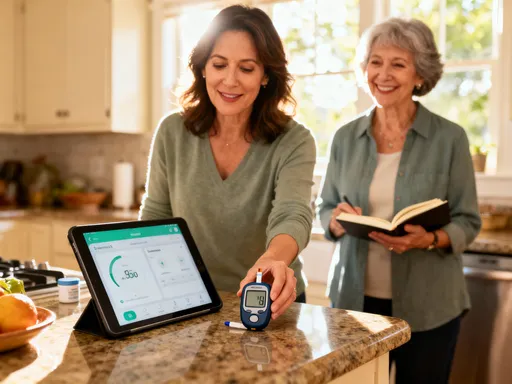
But here’s where it gets better. It doesn’t just store things. It helps you see progress. For example, instead of me saying, ‘I think Mom’s sugar has been better lately,’ I could actually show her—and her doctor—a chart of her glucose levels over the past three months. Not memory. Not guesswork. Data. Clear, simple, visual. And that changes everything. Because when you can see improvement, it’s not just hope. It’s proof.
And the best part? It’s not complicated. You don’t need to be tech-savvy. You don’t need to understand medical jargon. You just open the app, tap a few buttons, and it guides you. Want to log a blood sugar reading? There’s a spot for it. Need to set a reminder for her evening insulin? Done. Got a new lab report from the doctor? Snap a photo, and it saves it. No typing. No forms. No stress. It’s like having a quiet helper who never forgets, never judges, and is always there when you need it.
I’ll never forget the first time I showed it to my mom. She was skeptical. ‘Another gadget?’ she said. But when I pulled up her last six glucose logs and showed her the downward trend, her eyes softened. ‘I didn’t realize I was doing that well,’ she said quietly. That moment—small as it was—told me we were onto something. This wasn’t just about organization. It was about dignity. About feeling in control. About turning fear into confidence, one tap at a time.
From Chaos to Confidence: A Week in My Real Life
Let me take you through a regular week—nothing extraordinary, just life as it is now. Monday morning. Coffee’s brewing. My mom checks her blood sugar. She tells me the number, and I open the app, tap ‘log reading,’ and enter it. Takes ten seconds. While I’m there, I notice a reminder: ‘Insulin refill due in 3 days.’ I click ‘order now,’ and it sends a request to her pharmacy. Done. No phone call. No waiting on hold. No forgetting.
Wednesday. Doctor’s appointment—virtual this time. A few minutes before the call, I pull up the app. I select the last six months of glucose data, her recent lab results, and a log of her symptoms—tiredness, occasional dizziness. I hit ‘share,’ and it creates a secure summary the doctor can view during our visit. When the doctor joins, she says, ‘Wow, this is the most organized patient record I’ve seen all week.’ I don’t say it out loud, but I smile. Not because I want praise. But because for the first time, I feel like we’re on equal footing. Like we’re part of the care team, not just spectators.
Thursday. My dad has a check-up. He’s not the techiest person—he still uses a flip phone—but I helped him set up the app on his tablet. After the visit, the nurse hands him a stack of papers: updated meds, new referrals, lab orders. In the past, this would have gone into a folder, then a drawer, then oblivion. But this time, we sit in the car, snap photos of each page, and upload them. Takes five minutes. Now, everything’s saved. No more lost forms. No more ‘What did the doctor say about that test?’
Friday. My sister calls. ‘Did Mom’s medication change?’ she asks. Instead of playing phone tag or digging through emails, I open the app, check the updates, and send her a quick message: ‘Yes, dose increased on Tuesday. I’ve got the note from the doctor if you want to see it.’ She replies with a heart emoji. That’s the moment I realized: this isn’t just helping me. It’s helping all of us stay connected, without the stress.
And the biggest win? Time. I used to spend hours every week chasing details. Now, I spend maybe twenty minutes. And that time? I give it back to us. To laughter at dinner. To a walk in the park. To just sitting with my mom and talking—without a stack of papers between us. That’s the real magic. Not the app. The space it creates.
Progress That Feels Real: Why Tracking Changes How You Feel
Here’s something no one tells you: seeing progress changes how you show up in the world. Before, when I’d ask my mom how she was feeling, she’d shrug. ‘Same as always,’ she’d say. There was no way to measure ‘better.’ No proof. Just hope. But now? When she logs her numbers and sees the graph trending downward, something shifts. Her posture straightens. Her voice lifts. ‘I’m actually doing okay,’ she says. And she means it.
That’s the power of tracking—not just for the body, but for the heart. Because when you can see improvement, it becomes real. It’s not abstract. It’s not ‘maybe.’ It’s right there on the screen. And that visibility does something quiet but powerful: it builds belief. Belief that your efforts matter. That change is possible. That you’re not stuck.
Think about it like a garden. You don’t see the roots growing. But one day, you notice a new bud. And suddenly, you remember why you watered it every day. Tracking health is like that. You log a number. You take your pill. You eat a little healthier. Day after day, it feels invisible. But then—there’s the chart. The trend. The proof that you’ve been moving forward. And that’s when motivation kicks in. Not because someone told you to, but because you can see it with your own eyes.
I’ve watched my mom go from feeling helpless to feeling capable. From dreading appointments to looking forward to them—because she knows she’ll have answers. She’ll have data. She’ll have control. And that confidence spills into everything. She walks a little farther. She tries new recipes. She smiles more. It’s not the app doing that. It’s her. But the app gave her the mirror to see her own strength.
And for me? It’s eased the fear. The constant ‘what ifs.’ Because now, if something feels off, I don’t have to guess. I can check the trend. I can see if it’s a pattern or a one-time blip. And that knowledge? It’s like a deep breath after holding it for years.
Sharing Without Stress: Keeping Family in the Loop
One of the heaviest burdens I carried wasn’t the paperwork. It was the loneliness. I was the one who knew everything. The only one who could answer the doctor’s questions. The only one who could explain the meds. And when I got sick, or went on vacation, or just needed a break—there was no backup. I felt like the single thread holding it all together. And I was terrified of snapping.
Then I learned about secure sharing. It’s not about posting health updates on social media. It’s about giving the people you trust access to the information they need—nothing more, nothing less. I added my sister as a viewer. She gets notified when there’s a medication change or a new doctor’s note. My cousin, who lives two states away but checks in often, has limited access—just enough to see major updates. And my dad? He can view his own records anytime, no more relying on me to print things out.
Setting it up was simple. I chose who to invite, selected what they could see, and sent an invitation through the app. They accepted, verified their identity, and just like that—everyone was on the same page. No more repeating myself. No more frantic texts. No more feeling like I had to be everywhere at once.
The relief was immediate. Not just for me, but for them. My sister told me, ‘I used to feel helpless. Now I feel like I’m part of it.’ My cousin said, ‘I can stop worrying so much. I know I’ll be updated if something changes.’ And my mom? She said, ‘It’s nice knowing we’re not alone in this.’
That’s the thing about health—it’s never just about one person. It’s about the whole family. And when information flows freely, gently, securely, it builds connection. It turns fear into trust. It turns isolation into teamwork. And that, more than anything, is what I wanted all along.
Getting Started Without the Overwhelm
I know what you’re thinking. ‘This sounds great, but I don’t have time to figure out another app.’ I thought the same. So let me tell you how I started—small. Real small. I didn’t try to upload every medical record from the past ten years. I didn’t create perfect logs. I just opened the app and added one thing: my mom’s diabetes diagnosis. That was it. One entry. Took two minutes.
The next day, I snapped a photo of her current medication list. Just one. Then, I set one reminder—for her morning pill. That’s three actions. Three tiny steps. And already, I’d done more than I had in months of trying to keep it all in my head.
Here’s what I wish someone had told me: you don’t have to be perfect. You don’t have to catch up on everything at once. Start with one condition. One document. One reminder. That’s enough. Progress isn’t about how much you do. It’s about showing up.
And if you ‘mess up’? If you forget to log a number or miss a day? That’s okay. This isn’t school. There’s no grade. No penalty. Just you, doing your best. I’ve had weeks where I didn’t log anything. Life got busy. But I didn’t delete the app. I didn’t give up. I just started again. And each time, it got a little easier.
Try this: this week, pick one thing. Maybe it’s tracking your own blood pressure. Or logging your dad’s weekly symptoms. Or just scanning one important document and saving it. That’s your win. Celebrate it. And when you’re ready, add one more. You’re not building a perfect system. You’re building peace. And peace doesn’t come from perfection. It comes from progress.
A Calmer Future, One Tap at a Time
Looking back, I see how much we’ve gained—not just in order, but in joy. The frantic energy that used to fill our home has softened. Doctor visits don’t feel like exams we might fail. We walk in with confidence, with answers, with a shared history at our fingertips. My mom feels seen. My family feels included. And I? I feel lighter.
This journey wasn’t about replacing human care with technology. It was about using a simple tool to support the love and effort we were already giving. The app didn’t heal my mom. Love did. Care did. Consistency did. But the app gave us the space to focus on those things—without drowning in details.
So if you’re standing where I once was—surrounded by papers, overwhelmed by responsibility, wondering how you’ll keep up—know this: you don’t have to do it all at once. You don’t have to be perfect. You just have to start. With one tap. One photo. One log. And from there, peace begins to grow.
Because the real win isn’t in the data. It’s in the quiet moments that return—the shared meals, the laughter, the deep breath before an appointment. It’s in your mom saying, ‘I think I’m getting better.’ It’s in knowing you’re not alone. That’s the future we’re building. Not with grand gestures, but with small, steady steps. Together. One tap at a time.